
In using the word feeble in a recent email, someone asked, “What is the criteria for a ‘feeble follow-up?’ Just curious.” Follow-up that is ignored is of course the feeblest type of follow-up. It isn’t going on this list because you intellectually, and intuitively, know this. Just fathom the results of these top ten feeble follow-up attempts: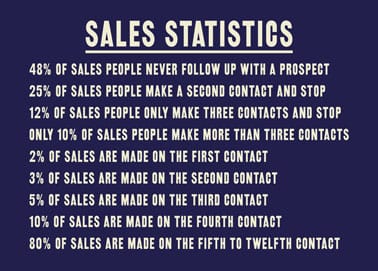
-
1. Overusing I. Like selling, follow-up is more about the customer or the prospective customer. A follow-up with more you than I, me, and mine is a stronger type of follow-up.
2. Repeating your first or previous contact. Yawn, b-o-r-i-n-g. Have something to say or write about that is both worthwhile and different on each of your follow-up calls.
3. Not personalizing. Even if the new product or service is something you are telling everyone about, make it unique for the person you are following-up with.
4. Ending without a call to action. It’s your third, seventh or ninth contact. Ask for some kind of action: is this new product something of interest that I can stay in touch with you about? What’s our next step? Call for a decision of some sort.
5. Taking too long. Use your listening skills to determine the decision making criteria of your prospect. Too long for you may be too short for the prospect. Too short for the prospect may be what gets you a rap as a pest. It’s not your time line of wanting that is important but the customer’s time line of need.
6. Using the clichéd, “Did you get my email?” How weak! If you sent an email it’s better to say, “I’m following up on a recent email I sent because there is something important I want to ask you about.” Take a previous follow-up contact to a stage of answering the unasked question your prospect might have.
7. Not having a plan or a system. Do you have a stack of business cards staring up at you? Then you don’t have either a plan or a system.
8. Not taking advantage of rejection. They said no. Big deal. Hopefully you have uncovered the reason for rejection: ask for understanding the decision to help you get better. Or you might even want to ask for a lead. A referral may be possible as well.
9. Making more statements instead of asking more questions. This is kin to overusing I. Before you start down a presentation path, be a bit more curious. Let your prospect tell you the address you need to be at, what they are interested in knowing.
10. Giving up too soon. Those dang statistics tell us over and over again: 80% of sales are made on the fifth to twelfth contact. Yet, only 10% of sales people make more than three contacts. Your prospective customer wants you to know – you’re losing interest in me too soon.
Both 4 and 5 are my Achilles heel. I’d like to blame it on introversion tendencies – but you and I know that is just as weak as the feebleness of the lack of action!
What feeble follow-up attempts have you experienced on either side of buying and selling?
I’m offering a free 25 page excerpt from How to Steadily Turn Prospects Into Customers: Taking the Mystery Out of Follow-up Reluctance and Enjoy Your Work. Learn easily and quickly how to go from collecting business cards to a 30% to 100% increase in sales and, if you like, experience it without going to ONE more networking event.
Thanks for the list. Awesome insights. Have you thought about breaking it into before, during, and after the follow-up?
Thank you for the comment Neil! And, what a terrific idea about before, during and after. The only one that COULD be a bit difficult for me is the before – what do you have in mind for follow-up before? Actually, in my 30 years in sales I have done some pretty darn attention getting things BEFORE I even made a telephone contact. Is that the kind of thing that came to your mind? For example, for years I was tasked with calling attorney firms. There was one firm I REALLY wanted to get into. After I made a telephone call to find out who I would need to speak with, but BEFORE I called them, I mailed them a tea cup – with no tea. I said I would deliver the tea bags. Got me a first appointment. And a training gig ensued!
The “before” I was thinking about was the “before the follow-up.” That would lead to review of the initial contact, what to avoid this time, and maybe even some questions to ask. These ideas would tie in 4, 6, 8, and 9.
Hi Pat,
Great advice. Regarding your #10. How does one determine what is “too soon”? I would think after several ignored follow-ups at some point, one becomes “spam”? What is your opinion on this?
Thanks Pat for your answer. Yes I think that email has changed the game a bit and the SPAM equation comes into play. I do like that though, keep going until someone tells you to “stop”.
Neil – OK. Sounds like some good blogging ideas for either you or I. Who will start?
Julie, what is “too soon?” GREAT question. I state more in my eBook however, opinions vary on how many follow-up contacts are needed. The National Sales Executive Association found that that 80% of sales results are made the 5th to the 12th contact. I continue to follow the advice of one of my early sales managers because I asked a similar question. He said, “You follow-up until they tell you to STOP.” Granted that was before email. But, people are people. Your client is going to be ready to buy when the PAIN of lacking a solution is so bad. It’s up to you to manage the follow-up time line by understanding their pace and style of decision making.
Pat,
Very good post. 80% after the 4th contact. I did not realize it was that high. Makes sense when you think that people buy people not products. It takes time to build that relationship. Also, people are not ready to many times the first time you contact them. I have put off a number of sales people because the timing was not right.
Jim
A persistent pawn:
Q. How many pawns does it take to change a light bulb? A. One, but it takes all knight.
Jim, I think your pun fits nicely here:
Q. How many contacts does it take to help a customer buy? A. One, the last one.
I like that Q/A. I tweeted it.
Pat, #10 – “giving up too soon” is definitely my biggest weakness. I always feel like I’m nagging. I don’t even like to tweet more than once. Although, I’ve been convinced that you need to tweet each post as least 4 to 5 times a day to reach the largest number of your followers. I keep reminding myself that I have to do this sort of thing. I’ll have to remember your statistics.
Sherryl, also do take a look at my Amazon book, Taking the Mystery Out of Follow-up at http://amazon.com/author/patriciaweber – the excerpt handles many feelings like nagging.
I loved the part of giving up to soon. I always believe you do not want to overdo it. Maybe i will rethink that strategy.